
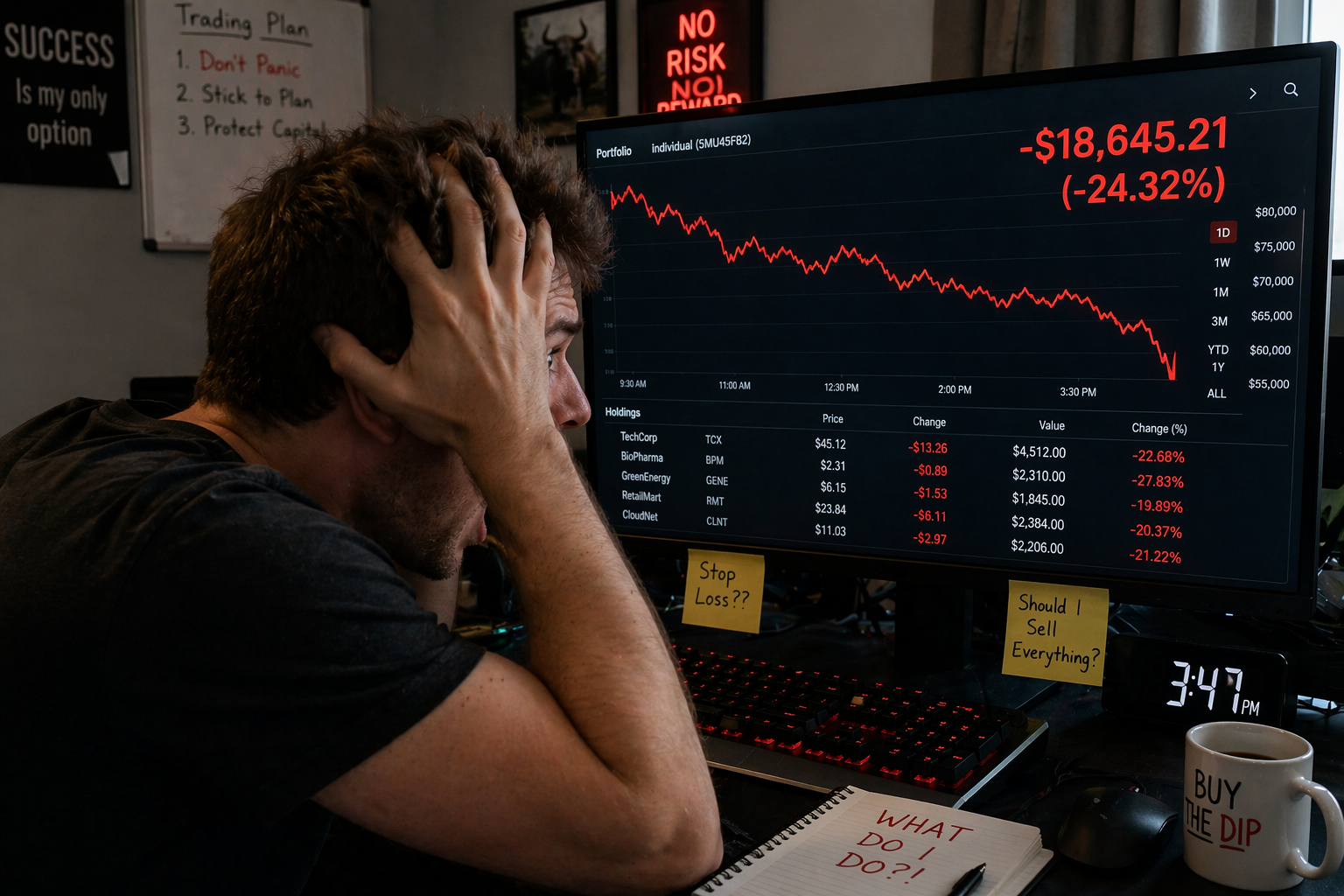
The market is a sea of buyers and sellers. When one side dominates, prices move in a straight line — more buyers than sellers means prices rise, more sellers than buyers means prices fall. It's the same dynamic you see in housing: when there are more buyers chasing fewer homes, prices go up. When the reverse happens, prices come down. Simple.
Most investors intuitively understand buying. What confuses people is why anyone would ever sell. If stocks go up over time, why cash out? The answer is actually simple once you break it down.
Four reasons people sell
Why someone is selling your stock right now
The house you don't own
Here's the short-selling concept in the simplest form I know.
Imagine you sell a house you don't own. Someone agrees to buy it from you for $500,000. They're going to move in next month. Since they're not moving in until next month, you don't actually have to hand over the keys yet. You're betting you can find that same house cheaper before they move in, then hand it over and pocket the difference.
That sounds insane, but it's exactly how short selling works in the stock market. You sell shares you don't own at today's price, and you're on the hook to "deliver" those shares later — ideally after buying them back at a lower price.
You can make money both ways:
when the stock goes up, and when it goes down.
Quick example. If you short Tesla at $440 and the stock drops to $429, you buy back at $429 and pocket $11 per share. Short 100 shares, that's $1,100 profit on a $11 move. Not bad.
A word of caution
Shorting is how a lot of retail investors blow up their accounts. When you buy a stock, the most you can lose is 100% of your investment. When you short, the stock can theoretically rise forever, and your losses have no ceiling. A stock at $20 that you shorted can run to $200, and you're on the hook for the difference. If you're new, understand the full mechanics before you try it. Better yet, stick to the long side until you have a lot of reps under your belt.
Reading the trend with EMAs
I reference the Exponential Moving Average, or EMA, all the time. Here's why it matters.
The EMA smooths out the noise of daily price moves and shows you the underlying trend. Compare it to the Simple Moving Average (SMA), which gives every day equal weight. The EMA weights recent days more heavily, which means it reacts faster when the trend is changing. It also gives you a signal when a stock has gotten too hot — meaning price has stretched too far above the EMA and is due for a cooldown.
A recent example from gold. One morning I was watching $GLD pull back, and I noted the 8-day EMA was sitting at $362 while we'd opened the session at $373. That's a stretched position — price was running well above its short-term trend line. Guess where gold found support intraday? $362 and change. It cooled off just enough to stay bullish, then resumed the uptrend.
That's what the EMA does for you. It doesn't predict exactly where a stock will go, but it tells you what the trend looks like and gives you an objective reference point for "too hot" or "too cold."
The two takeaways
I write these posts with a 20-minute lecture rule in mind. Attention spans are limited and retention is worse, so I keep things tight. Here's what I want you to walk away with.
Takeaway 01
Do not panic sell.
Markets ebb and flow. If the underlying business is solid, the stock should do well over time. Knowing the basics of charts helps you figure out when your position is still on track and when it's genuinely broken down. The most expensive mistakes retail investors make are emotional, not analytical.
Takeaway 02
Take some profits to buy the dips.
This doesn't mean sell everything. If you're up 25% on a 100-share position, maybe sell 10 shares. If you're up 100%, consider selling half — the rest is pure profit that rides for free. I trimmed a small amount of $PATH recently because it had moved a lot, but I still hold most of the position since the thesis hasn't changed. If the stock pulls back, I've locked in some green. If it keeps running, I still have exposure. That's the balance you're looking for.
Figure out what works for you. There's no single right answer — just a lot of wrong ones to avoid. And panicking in the middle of a pullback is almost always one of the wrong ones.
Want more of this?
Office Visit members see my trades in real time with the full reasoning. Plus weekly macro breakdowns, single-name research, and the #trade-desk Discord channels.
Tiers start at $9.99/month. 100% of membership profits donated to kids and schools in our community.
— Doc