
Demand, Supply, and Money
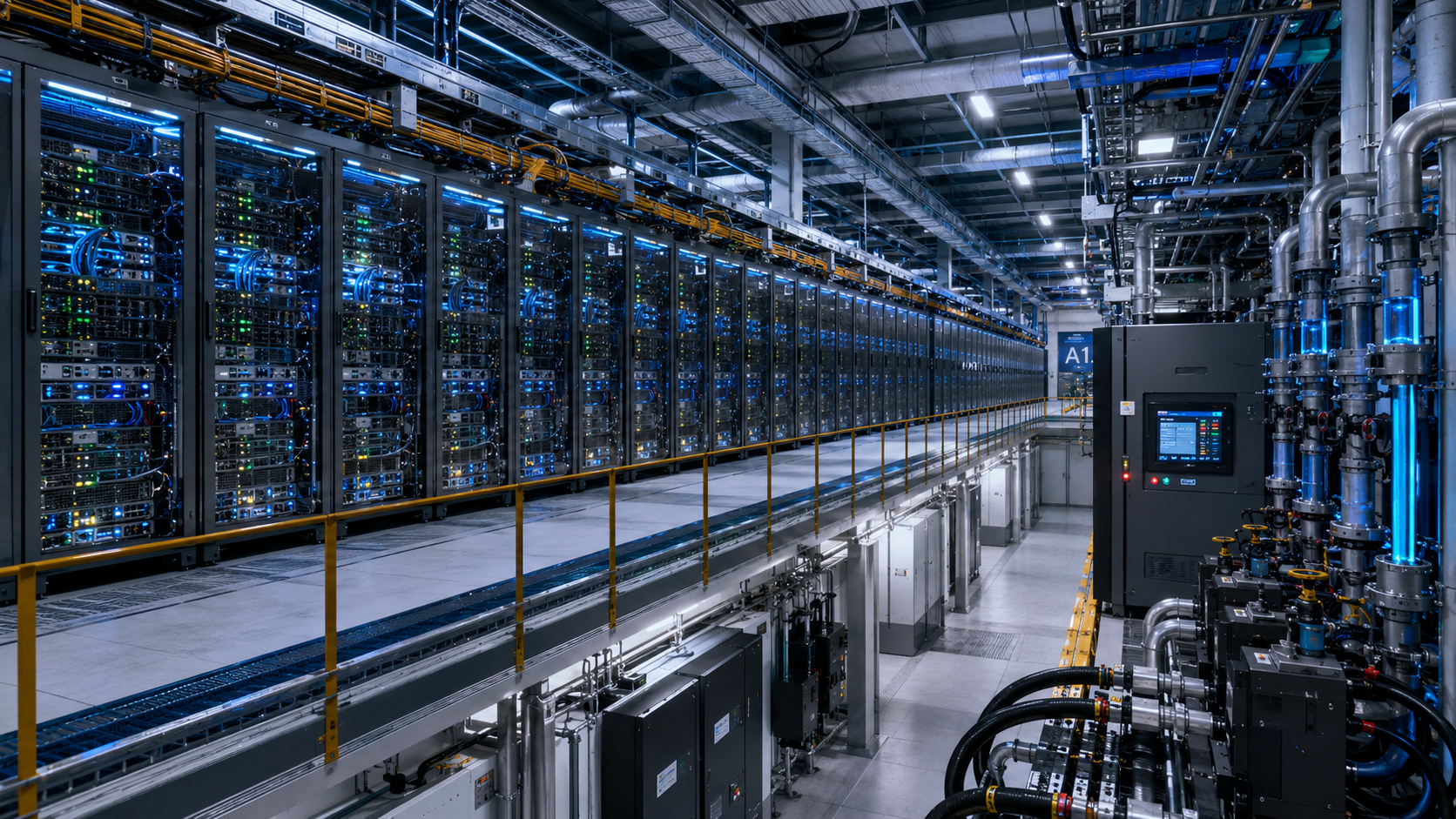
AI programs need computers and those computers live in buildings called data centers. We can see that demand for those computers is growing faster than companies can build the places to hold them.
To break this down, we need to lay out the facts on six things:
- How fast demand is growing
- Where the shortages are
- How much money is being spent
- How that money is being raised
- What the stock market has done
- What the main arguments are on both sides
Part 1: The Key Facts
Demand
- Google processed 9.7 trillion tokens per month in May 2024. By May 2026 that number passed 3.2 quadrillion per month. (A token is a small piece of text that an AI model reads or writes)
- Microsoft processed more than 100 trillion tokens in a single quarter, which is about 5x compared to a year earlier.
- AI infrastructure spending to reach about $1.4 trillion in 2026. That is up about 42% in one year.
Supply
- The largest data center market is in Virginia and available vacancy fell to 0.3% earlier this year.
- About 96% of all new space scheduled to open this year was already claimed before it was built.
- In some parts of the country, connecting a large new building to the power grid can take up to 10 years.
- Lead times for large power transformers have stretched to about 4 years.
Spending
- The four biggest cloud companies spent a lot on buildings and equipment = $226 billion in 2024 → $410 billion in 2025 → $725 billion estimated for 2026.
Money
- These companies used to pay for the buildout with their own cash hoards, but it's been changing lately. They are now borrowing money. Borrowed money went from about 9% of their spending in 2024 to about 32% so far this year.
- On August 10, 2026, NVIDIA announced a plan to connect folks with six large banks and the $500 billion from outside investors.
- Then just a week later on August 17, NVIDIA told the SEC it would guarantee up to $105 billion in payments for an OpenAI data center in Ohio.
Market
- NVIDIA closed at $219.74 on August 18 with a market value of about $5.31 trillion.
- The stock trades at about 25 times expected earnings. Its five year average is closer to 72 times.
- Chip stocks rose 86% in the first half of 2026, but fell about 29% so far this month
Part 2: How Fast Demand Is Growing
Token counts
The clearest measure of AI use is the token. Every time an AI model reads a question or writes an answer, it uses tokens (a small chunk of text). Companies bill customers by the token usage.
Google reported these numbers:
| Date | Tokens per month |
|---|---|
| May 2024 | 9.7 trillion |
| May 2025 | About 480 trillion |
| May 2026 | More than 3.2 quadrillion |
Absolute insane growth.
Microsoft said it processed more than 100 trillion tokens in ONE QUARTER. That was about 5x higher than the year before. In March 2026 alone it hit a record 50 trillion.
OpenRouter (a company that routes AI requests) said its weekly token volume grew 5x within 6 months. It went from 5 trillion to 25 trillion per week.
Forecasts keep missing
Dell raised its forecast for 2028 token use by 57x, but its current usage is already ahead of that estimate.
Global AI computing power is doubling about every 7 months. Token demand is growing faster than the supply of computers to serve it.
Estimates of total AI infrastructure spending for 2026 is near $1.4 trillion.
Buyers say they cannot get enough
Company managers have said it directly:
- Microsoft has about $80 billion in Azure cloud orders it cannot fill. The reason given is a lack of power.
- Amazon has said AWS will be short on capacity into 2027.
- Alphabet management has repeatedly described the company as supply constrained.
Signed orders (not estimates) waiting to be filled are large and growing:
| Company | Contracted orders not yet delivered |
|---|---|
| Microsoft | $678 billion |
| Google Cloud | $514 billion ($240b end of 2025) |
| Oracle | Over $300 billion |
| Nebius | $99.4 billion |
| CoreWeave | $66.8 billion |
Part 3: Where the Shortages Are
The shortage used to be about computer chips, but now it's all about the buildings, electricity, power equipment, memory chips, and cooling.
Shortage 1: Buildings
Northern Virginia is the biggest data center market in the world. Here is what it looked like at the END of 2025:
- Total space: 4,040 megawatts (up 37% in one year)
- New space built in 2025 = more than 1,000 megawatts
- Empty space available: about 21.5 megawatts
- Vacancy rate: 0.5%
- Share of 2026 space already claimed: 96%
By early 2026, vacancy was at 0.3%. That is an all time low.
The picture is similar across other major markets:
- Vacancy across all primary U.S. markets hit a record low of about 1.4% at the end of 2025.
- Supply GREW 36% that year, and it still was NOT enough.
- Rent for a small space, 250 to 500 kilowatts, rose to about $196 per kilowatt per month. That was the fourth straight yearly increase.
- Rent is expected to pass $200 per kilowatt per month.
- About 70% to 75% of space under construction is rented BEFORE it opens. The normal historical rate is 40% to 50%.
There is nothing available to rent. It's a seller's market as they say in real estate.
Shortage 2: Electricity
Power is now the hardest limit on new construction.
Build times have grown. Buildings used to be "small" at under 50 megawatts which would take 12 -18 months. Now the buildings are turning into their own campuses of 500 megawatts or more, which need their own power substations. The problem is further compounded if new high voltage lines or new power plants are needed, then the wait can stretch to 2 - 4 years. If they want to try to hook onto the grid with those kind of power needs, it could take up to 10 years! The waiting lines are long.
- U.S. grid connect queues passed 1,500 gigawatts in 2025
- The Texas grid operator ERCOT has a queue of about 226 gigawatts, with most of it (165 gigawatts or 73%) was data center projects.
- PJM, which runs the grid across much of the East, says data centers account for 94% of its expected 32 gigawatts of peak demand growth through 2030. Demand is growing about TWICE as fast as new power supply.
The equipment itself is short. Even with permission to connect, a project needs physical hardware. Lead times for large transformers have reached about 4 years, mainly because a special material called grain oriented electrical steel is 60% controlled by China.
Some builders gave up waiting. Many projects are so desperate to get things going, they are moving ahead with their own natural gas power plants on site. One operator near Dublin built a separate private grid because the wait for a public connection had no clear end date.
Shortage 3: Cooling and Power Density
The machines are getting much hotter and much more power hungry.
Average power per equipment rack:
| Year | Average rack power |
|---|---|
| 2025 | About 16 kilowatts |
| 2026 | About 27 kilowatts |
AI work already uses racks of 50 to 70 kilowatts, so many of these racks are not even built to fulfill current needs.
NVIDIA's product line is far past that:
| System | Power per rack | Timing |
|---|---|---|
| GB200 NVL72 | 120 - 130 kilowatts | Shipping |
| GB300 NVL72 | 132 - 142 kilowatts | Shipping |
| Vera Rubin VR200 NVL72 | 190 - 230 kilowatts | Late 2026 |
| Rubin Ultra "Kyber" | 600 kilowatts | 2027 |
AIR cooling stops working well above 40 - 50 kilowatts per rack. LIQUID cooling is now required. Like power, cooling needs are behind the capability in these buildings. Only 22% of current sites have liquid cooling with that expected to increase to about 40% by the end of 2026.
Power delivery is also changing. NVIDIA and its partners are moving to 800 volt direct current systems. NVIDIA says this pushes more than 150% more power through the same copper wiring, which is great because the cost of copper has been climbing with the increased needs.
Schneider Electric originally planned 600 volt systems. It moved straight to 800 volts because 600 could not handle the coming machines.
As you can see, each generation of chips and products makes the current electrical designs outdated. This means that current data centers need to be redesigned and restructured frequently. Imagine having an apartment building having to do full renovations almost yearly!
Shortage 4: Memory Chips
High bandwidth memory, or HBM, is the special memory used in AI systems. There is a whole research report on The Clinic about it. Making HBM uses about 3x more factory capacity per gigabyte than regular memory. Unfortunately for customers, that capacity came out of regular memory for servers and consumer devices.
- In 2026, HBM used about 23% of world memory factory output (vs about 8% in 2024)
- Memory contract prices rose roughly 80% - 95% in a single quarter heading into 2026.
- Some DDR5 memory parts rose 3-4x.
- SK Hynix said its HBM, DRAM, and NAND supply was essentially sold out for 2026. In July 2026 its CEO said the shortage may last past 2030.
- Data centers now use an estimated 70% of all memory chips made worldwide.
Now companies are spending more money due to this supply shortage. Microsoft said about $25 billion of its 2026 spending was due to higher component prices.
The rest of this reportThe sections above cover demand and the physical shortages. The remainder covers the money: what the four biggest cloud companies are spending, how they are now borrowing to pay for it, NVIDIA's two August financing deals, current market prices and valuations, the arguments on both sides, the companies in each layer of the supply chain, the identified risks, and the indicators to track from here.
This report is for education and research. It is not personalized investment advice, and the author is not a licensed financial advisor. Full disclosures and position disclosures appear at the end of the complete report.