
Quantum Computing
A Retail Investor's Guide
What to own, when to own it, and how much to risk. A research paper from The Clinic.
Why the hype?
Quantum computing might be the most hyped, but least understood corner of the market right now. Everybody has heard it is “the next big thing.” Recently, Trump has signaled that quantum is a “national priority” and wants to be ahead of the curve especially for cybersecurity. The problem is the technology is still so new and revolutionary that not many people can tell you what it actually does, when it pays off, or how to best own it.
You have probably heard that quantum will SUPERCHARGE artificial intelligence. It will not for many years. For now AI runs quantum through the GPUs and AI models we are familiar with through the likes of NVIDIA. These systems are the babysitters keeping fragile quantum machines from falling apart.
We need to be realistic about quantum right now, as it seems that many are hoping quantum is a second AI rocket ship that can be strapped onto the portfolio. The quantum market today is TINY next to AI. The science is moving fast, the stocks are on fire on a price to book value, and most of the money you will make or lose here comes down to timing and the size of the bet. Let’s diagnose this space.
The Diagnosis: Where Quantum Actually Is in 2026
How it works: a normal computer bit is a light switch. On or off translated as a 1 or a 0. A quantum bit, or QUBIT, is more like a flipped coin in mid-air. It can be heads, tails, or a blur of both at once. This means that if you line up enough spinning coins the right way, they can explore a vast number of possibilities at the same time. This would be an amazing feat, but those spinning coins are INCREDIBLY fragile. A tiny bump, a little heat, a stray wave, and the coin falls over and the explorations are a bust.
For almost 30 years, that fragility was the wall. In December 2024, Google finally broke through with a chip called WILLOW, which has 105 qubits. The breakthrough was when they grouped qubits together to check each other's work, adding MORE qubits made the error rate go DOWN instead of up. Scientists call this “below threshold” = the physical error rate of the quantum system is lower than a critical threshold. This is essential because, below this threshold, the error rate of the encoded quantum information (logical error rate) decreases exponentially as the number of physical qubits used for encoding increases.
Then in October 2025, Google ran a special algorithm on Willow that beat the world's fastest supercomputer by about 13,000 times on a physics problem!
Ok that’s great, so when quantum? The problem is that those error rates are still WAY too high for real work. Google itself admits you might need over a THOUSAND physical qubits just to build one good “logical” qubit. We are still in the early stages of fault tolerance, so basically the FOUNDATION ERA. We got the fundamentals, but not ready to make it to the app store.
Types of quantum
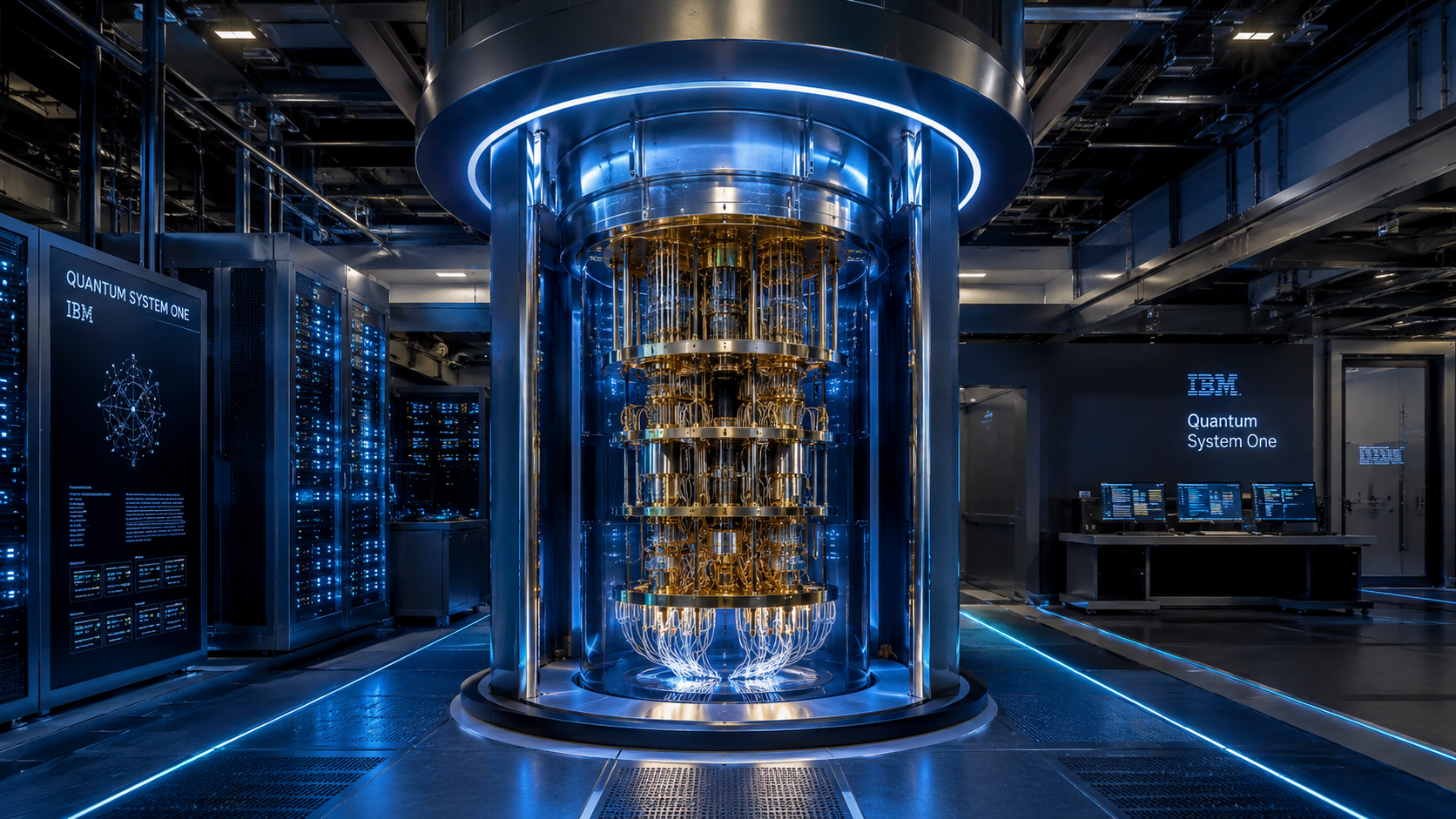
Superconducting quantum is the “silicon chip” style. Companies like IBM and Google have pushed this path hard. The qubits are tiny circuits, but they only work when cooled near absolute zero. That makes the systems complex and expensive. The upside is speed and chip-manufacturing familiarity. The downside is noise, heat, wiring, and the need for big cryogenic systems.
Trapped-ion quantum uses real atoms that have an electric charge. The machine traps them with electromagnetic fields and controls them with lasers or microwave signals. These qubits are usually very clean and accurate because atoms are naturally identical. The problem is scaling since controlling a few or dozens is one thing, but controlling huge numbers is much harder.
Neutral-atom quantum also uses atoms, but the atoms have no charge. Lasers hold them in place like tiny optical tweezers. The big appeal is that you can arrange lots of atoms in neat patterns, almost like seats in a stadium. This is why neutral atom is getting attention as a scaling play.
Photonic quantum uses light itself. The qubits are photons. This is attractive because light is already how we move information across fiber networks. Photonics could be strong for quantum networking and chip scale optical systems, but photons are hard to make interact with each other, which makes computation tricky.
Put simply: Superconducting is the most “chip-like.” Trapped ion is the “high accuracy” path. Neutral atom is the “scale lots of qubits” path. Photonics is the “light and networking” path.
There’s no clear winner, so the likely future may be hybrid, where quantum chips, lasers, optics, GPUs, and classical computers all work together.
| Type | What the qubit is | Easy analogy | Main strength | Main weakness |
|---|---|---|---|---|
| Superconducting | Tiny electrical circuits cooled extremely cold | A quantum computer built like a special chip | Fast. Chip-based. Big ecosystem. | Needs giant refrigerators. Qubits are noisy. |
| Trapped-ion | Charged atoms held in place with electric fields and controlled by lasers | Floating atoms in a laser cage | Very accurate qubits. Atoms are naturally identical. | Gates can be slower. Scaling to huge machines is hard. |
| Neutral-atom | Atoms with no charge held by laser “tweezers” | A grid of atoms picked up and moved by light | Can pack lots of atoms into arrays. Good scaling story. | Still maturing. Control and error correction are the big tests. |
| Photonic | Particles of light, called photons | Computing with light instead of wires | Great for networking and room-temperature optics. | Photons do not naturally interact much, so logic gates are hard. |
AI runs quantum
So where does AI fit into quantum?
Quantum computers with qubits are powerful, but they make mistakes fast.
That means the machine needs something watching it at all times. Something that catches the errors, fixes them, and keeps the system stable in real time.
That is where AI and GPUs come in.
A quantum chip is not working alone. It needs a powerful regular computer next to it. The quantum chip does the quantum work. The GPU helps guide it, correct it, and keep it from falling apart.
$NVDA saw this and are not trying to build the quantum computer itself, but instead they are building the bridge between quantum chips and GPUs. That bridge is called NVQLink.
NVQLink lets a quantum chip talk to an NVIDIA GPU at very high speed. This is important because error correction has to happen instantly.
NVIDIA is also using AI models to help calibrate the quantum machine. Basically, the AI helps tune it, monitor it, and keep it running correctly.
Jensen Huang said “AI is essential to making quantum computing practical.” His view of the future in quantum computing is not just a quantum chip by itself. It is a hybrid machine with the quantum chip plus GPU.
This means the safest way to “own quantum” today might be owning the classical AI hardware that makes quantum possible, not gambling on quantum chipmakers themselves.
The Prognosis: The Quantum Timeline
Nobody knows the exact dates, but here is the rough map most experts agree on.
Now to ~2028, the Foundation Era. Bigger and better chips with error correction getting proven out. The cloud access gets sold mostly to researchers, instead of real customers so there isn’t any real serious profitability yet.
~2028 to 2030, First Real Fault Tolerance. This is when the first genuinely useful machines show up. $IBM says it will build a system called Starling by 2029 with about 200 “logical” qubits (built from roughly 10,000 physical ones). $IONQ has published a blueprint aiming for thousands of “logical” qubits, with testing of its big chip starting around 2028. If these come to fruition, then the first business uses start to appear, probably in chemistry.
Early to mid 2030s, Utility Scale. Quantum sits in the data center as a special tool for simulating nature. Building upon the chemistry discoveries, this should lead to better batteries, drugs, and materials.
~2035 to 2040, the Crypto Reckoning. Nobody can pull this off yet, but eventually a big enough quantum machine would be a massive cybersecurity threat. It could crack the encryption that protects your bank, your email, and even cryptocurrency. Cyber criminals are already stealing scrambled data today to crack later “harvest now, decrypt later”. That is why new “quantum-safe” encryption standards landed in 2024 and the upgrade is starting.
These timelines are just estimates when it comes to quantum. The future continues to feel close, but keeps getting pushed back.
The Big 2026 Shifts You Need to Know
Three things changed the game in 2026.
1. The pure plays went public
In June 2026, Quantinuum (ticker $QNT) IPO'd on the Nasdaq. Quantinuum builds TRAPPED ION quantum computers and is backed by Honeywell, which still owns roughly half. It raised about $1.68 billion and got valued around $14 billion to $15 billion. Unfortunately, that $14 billion price tag is over 450 TIMES the company's 2025 revenue of about $31 million. Even worse is that revenue actually FELL in early 2026. This is not a company you buy for its earnings, but rather you would be buying a bet on the year 2029 and beyond.
And $QNT was not alone. Two others came to the public market in 2026 via SPACs. $INFQ (Infleqtion) listed in February using NEUTRAL ATOM technology, and $XNDU (Xanadu) followed in March as the first PHOTONIC name.
2. The U.S. government became a shareholder
In May 2026, Washington agreed to put about $2 billion into nine quantum companies and take ownership stakes in return, using CHIPS Act money. $IBM is the big winner with around $1 billion (and IBM is putting up another $1 billion of its own to build a U.S. quantum chip factory). $GFS gets $375 million. Seven more companies split the rest at up to $100 million each. The public pure plays in that group are $QBTS, $RGTI, $INFQ, and $QNT, alongside private firms like PsiQuantum, Atom Computing, and Diraq. Notably, $IONQ was left off the list entirely.
Why does this matter? Two reasons. It hands these companies a CASH CUSHION, which is huge for businesses that burn money. And it signals that quantum is now national priority tech, like chips and rare earths. (Full disclosure: I am personally long $IBM, $IONQ, $INFQ, $XNDU, and $GFS.)
3. One pure play in control
$IONQ is no longer a science project. In 2025 it became the first quantum company to clear $100 million in revenue (about $130 million, up more than 200%), and it is guiding for $260 million to $270 million in 2026. It is sitting on roughly $3.5 billion in cash and just bought a U.S. chip foundry to control its own supply chain. It’s still richly priced, still losing money, but a different animal than it was a year ago.
The Players
Let us meet the team. I’m sorting them into three groups by risk.
The ClinicResearch you can inspect. Tools you can use. Profits after expenses support kids and community.