
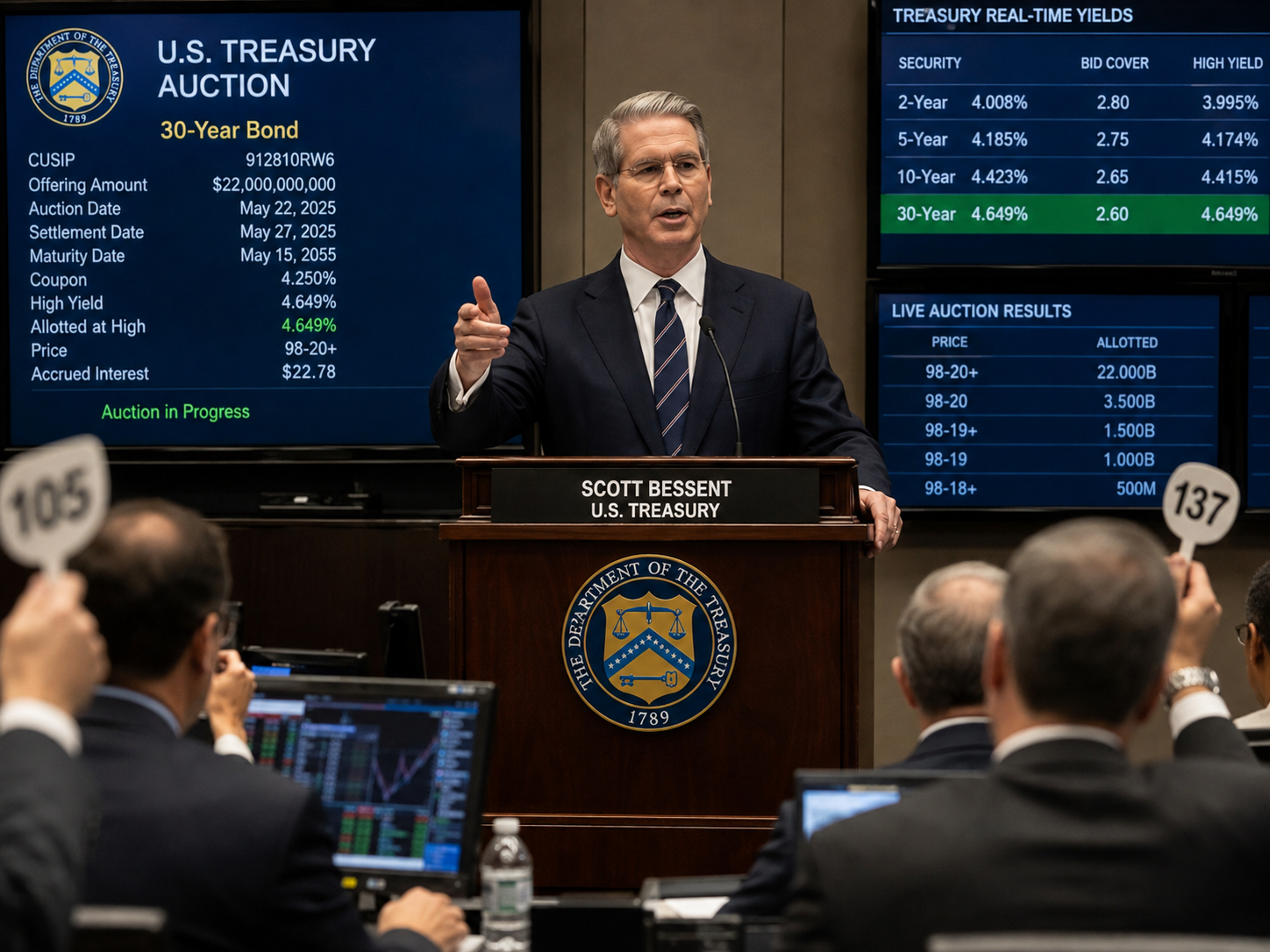
The Treasury doubles its bond buybacks while the Fed debates a rate hike
On August 19, 2026, the Treasury said it will double the size of its long-term bond buybacks. That same afternoon, the Federal Reserve released the July meeting minutes, and lo and behold, those minutes showed that several Fed officials wanted to raise interest rates.
That same day, the national debt crossed $40 trillion for the first time in history.
The Treasury is trying to push long-term rates down. The Fed is not helping. This is a quagmire because both are acting on the same economy at the same time.
The Treasury's move worked for less than one full trading session because by Thursday morning, long-term yields had given most of it back.
The Diagnosis
What the Treasury did
Treasury basically raised the size limit on its buyback operations from $2 billion to at least $4 billion, from September 9 to November 4.
The change covers two groups of bonds. One group matures in 10 to 20 years. The other matures in 20 to 30 years.
Like a company, the buyback is pretty simple. The Treasury goes into the market and buys back older bonds because those older bonds are harder to trade than new ones. They are like OTM options, with thin liquidity and wide bid-ask pricing. The slang for them is not "out of money" but instead "off the run." They are hard to dump if the market gets stressed. This is why it's great that the Treasury buys them, because pulling these less desirable bonds off the market helps the newer ones get more volume and liquidity. The newer ones are appropriately slang termed "on the run."
How the market reacted
Prices moved right away.
- The 10-year Treasury yield fell about 6 basis points to 4.647%. (A basis point is one hundredth of one percent.)
- The 30-year yield fell 9 basis points to 5.196%.
- The dollar fell to a 3 month low.
- Gold rose above $4,500 for the first time since early June.
- Long-term bond funds rose.
The timing was not random because just two weeks ago, the Treasury published its buyback schedule for this quarter. Then it intervened and switched course shortly after. Obviously governments do not pivot that quickly unless something is not working.
The relief lasted one session
Unfortunately the effect of the pivot faded fast. By the next morning, the 30-year yield rose 5.7 basis points to 5.251%, almost back to where it started the day before.
No buybacks had taken place yet since they don't begin until September. However, the market gave back the gains after digesting the announcement.
If you think about it, sure the buybacks may bring short-term relief, but it doesn't change anything for long-term yields if they stop buying those bonds in November.
Why long-term rates went up
The day before the announcement, the 30-year yield hit 5.337%, which is the highest level since 2007. The 10-year hit 4.75%, which was a 20 month high.
The 30-year has now stayed above 5% longer than at any point since before the 2008 crisis.
Despite Treasury Secretary Scott Bessent playing dumb (as to avoid blame of the administration for causing this), several forces pushed those yields higher.
- The July deficit was $432 billion. That is the worst July since March 2021.
- The deficit for this fiscal year is close to $1.8 trillion, with a few weeks left to go. Full year spending is expected to exceed revenue by more than $2 trillion.
- Total federal debt crossed $40 trillion for the first time ever. It was $39 trillion just five months ago.
- Treasury borrows roughly $155 billion every month.
- Inflation has stayed above the Fed's 2% target for five straight years.
- Crude oil sits near $86 a barrel, and the conflict with Iran is not settled.
- AI companies are now borrowing large sums as shared in the Data Center Research paper. However, the federal deficit needs to be funded by selling those long term bonds. If you're an investor looking to fund investment grade high quality debt, then you are shopping between AI data center buildout and treasury bonds. It is unlikely that a new cohort of debt investors are entering the market to bring in the buying volume of these debt offerings.
The buyer base is shrinking
Why did the Treasury act?
On August 18, Treasury ran a scheduled buyback in the 20 to 30 year range at the old $2 billion size. Here's the issue though, there were A LOT of investors who wanted to dump their bonds. We are talking in the neighborhood of $20 billion of bonds, whereas the Treasury could only take $2 billion off the sellers market. This is negative pressure when you have more sellers than buyers.
It gets worse. We talked about buybacks to take out old bonds. Yet, the deficit continues to worsen, so the Treasury actually has to sell new bonds to replace them and raise money. This is done with an auction.
The same week as the buyback, the auction showed similar problems. Not enough buyers. The Treasury sold $16 billion of new 20-year bonds, which seems good, but you have to look at the bid-to-cover ratio which details how many buyer bids are coming in for the bonds. The bid-to-cover ratio came in at 2.53, which is the weakest of 2026. It was 2.55 in May, 2.75 in June, and 2.64 in July. The demand of buyers is weakening.
Like an infomercial, "BUT WAIT! THERE'S MORE!"
The bidders in an auction are broken into three groups. Direct (domestic investors), Indirect (foreign investors bidding through a brokerage), and Dealers (the banks that the Treasury is working with for the auction).
Indirect bidders once again took the majority of the bonds with 62.9% of that auction. However, that was less than in June when they took 71.2%. At the 30-year bond auction the week before, indirect bidders took 66.8%.
Dealers had to absorb 12.5%, which is not something they want to do. The Dealers are just meant to be plan C, but they step in to be the backstop and buy what's left, hoping to sell it onto the market later. Ideally, more buyers means the Dealers don't have to absorb as much from the auctions.
It snowballs as the foreign investors are actually trying to SELL their bond holdings too on the market. Foreign holdings of Treasuries fell $72.1 billion in June. Japan sold $26.4 billion because their yen currency has been falling, so they needed to buy its currency on the open market = need US dollars to buy the yen = sell the US Bonds to raise that capital. China cut $25.9 billion of treasury bonds, but the reasons aren't as clear. Are they trying to diversify away from the dollar, as they have been buying a lot of gold recently? Are they trying to manage their currency like Japan? Are they playing geopolitics with our temperamental president?
Both Japan and China hold almost a trillion in bonds, so this selling was relatively modest, but still notable.
The core problemPut all of this together and you can see that the US has a massive problem. The Treasury is issuing MORE debt while some of its largest long-term buyers are stepping back. A bigger buyback cap does not fix that underlying problem. It's just a temporary bandage, and I think the market realized this, which caused the yields to flux the other direction the day after the Treasury $4b buyback announcement.
The Fed under Kevin Warsh
Kevin Warsh became Fed Chair on May 22, 2026. There are three key differences between JPow and himself on how he runs the Fed.
First, he stopped giving forward guidance. The Fed no longer tells markets what it plans to do next. You will find his statements are short and has said the Fed is not bound by market prices.
Second, he ended what traders called the "Fed put." Markets have assumed the Fed would step in if things got really bad over the past several years, but Warsh doesn't see that as his job.
Third, he treats 2% as the ONLY inflation target, and anything short of it is meaningless. He has called inflation "a choice."
The Fed is not close to cutting
Many folks still expect rate cuts, but the current data isn't supportive.
The Fed held rates at 3.50% to 3.75% in July by a vote of 9 to 3. Having three members dissenting is unusual, and they all wanted rates higher.
At Warsh's first meeting in June, almost half the committee expected rate hikes in 2026.
The odds of a September hike went from 80% in late July to about 30% recently. This is mostly because of weak economic data, but there really isn't any momentum behind a rate cut anytime soon.
What the July data showed
| July Report | Actual | Expected |
|---|---|---|
| Jobs added | Down 23,000 | Up about 80,000 |
| Inflation, year over year | 3.4% | Softer |
| Core inflation | 2.5% | Below estimates |
| Producer prices | Flat | Higher |
| Retail sales | Down 0.6% | Up 0.1% |
The data shows that the economy is slowing, but inflation is still above target. This puts the Fed in a tough spot, and is why the committee is split and decided to stand pat.
The Prognosis
The interest from debt
Congress approved about $901 billion for the military this fiscal year. Trump has asked for $1.5 trillion for next year, which would be the largest defense budget in American history.
$1.8 trillion is the deficit so far this fiscal year.
Federal net interest payments are on track to be around $1 to $1.25 trillion for fiscal year 2026.
Isn't that insane? We are currently paying more in interest payments on our debt than the amount we use to fund the largest military budget in the world. Interest is now the second biggest line in the entire federal budget, behind only Social Security.
Why the cost keeps climbing
The government pays an average rate of about 3.36% across all its debt, which seems low. This is because a lot of that debt was issued when rates were near zero.
However, you have now started understanding the cycle. As the old cheap debt matures, the Treasury replaces it at today's much higher rates. The 5-year yield is about 4.36% and the 10-year is about 4.65%.
This means that every month, more of that cheap debt turns into expensive debt. On top of that we have the average interest rate creeping higher.
To stop the rise, we would need market rates to fall at least a percent (100 basis points) down to that 3.36% average the government currently pays. There is nothing in our current economic conditions to support that move. The Fed isn't cutting rates and the Treasury buybacks are drops in a bucket. Throw in the fact debt buyers are stepping back unless paid more, you can see that things are not looking too rosy right now for our debt conditions.
How this compares to April 2025
In April 2025, Trump announced Liberation Day, which was essentially a shotgun tariff war with the world and the only thing it liberated were investors from their portfolios. The 10-year yield rose above 4.51%, and all of a sudden, Trump announced a 90-day tariff pause that same day. The president later admitted he had been watching the bond market.
The 10-year today is sitting higher at around 4.65%. There isn't a tariff pause TACO available. If anything, the trade war just got worse. Talks with Canada collapsed on Friday night and 50% tariffs on roughly $20 billion of Canadian goods took effect after midnight on Saturday. Prime Minister Mark Carney called it a miscalculation, said Canada is "at war," and will match the tariffs dollar for dollar starting September 8.
Compare today to 2025, and you can see the main problem. Last year, the bond market was able to react to a policy that could be reversed. Now in 2026, it is reacting to the growing debt problem, with no TACO possible.
How big is Bessent's $4 billion offer?
The Treasury borrows about $155 billion a month. If you take the $4 billion buyback and run it a few times per quarter, you can see its just not going to make much of a difference.
The Fed has a tool called quantitative easing (QE), where it basically prints money electronically and buys up the bonds with it. This causes bond prices to go up, and yields down and is meant to stimulate the economy when rate cuts aren't an option. In this case that we are looking at, its the Treasury stepping in, basically to keep up market maintenance.
However, I just shared earlier that during the August 18 operation there was about $20 billion worth of bonds being sold. Scott Bessent offering $4 billion instead of $2 billion will still not be enough to offset the sell side imbalance.
My sense is that yields will remain sticky, unless Bessent ups the offering above $4 billion. If oil starts flowing out of the Gulf, then that would also help. Otherwise we may have a situation where the Fed needs to print more money to buy up bonds.
There's a term called yield curve control (YCC) which is like QE except there isn't a budget on the Fed money printer, but rather achieving a specific yield goal regardless of the cost.
Doc's Orders: How I want to position
This paper focuses on one risk:
- The bond market is repricing, foreign buyers are stepping back, and the Fed is not coming to help.
I'm not one to swing entire portfolios around a single forecast, but rather "shift" the balance in a specific way.